Let’s Go Parallel
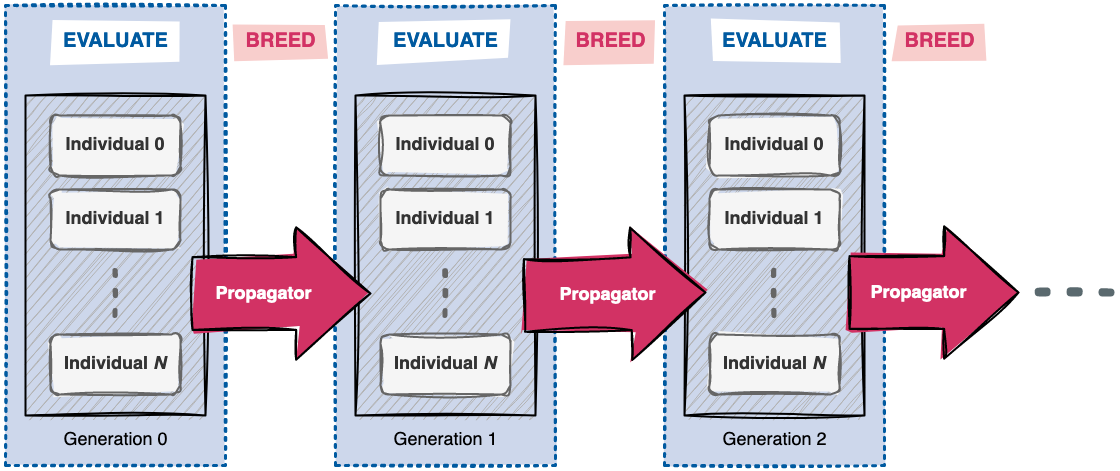
Since the individuals in each generation of a population-based algorithm are typically independent, they can be evaluated in parallel.
Why Synchronous Parallel Evaluation Sucks
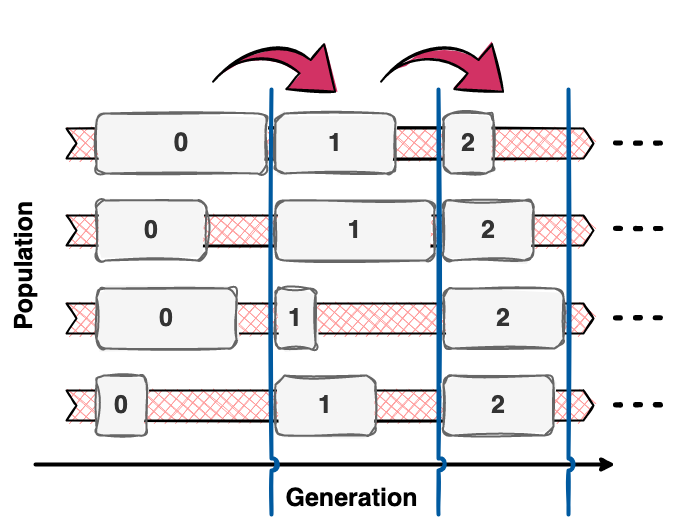
Typically, all evaluations of the current generation have to be completed before the next one is bred synchronously from the discrete population of the last generation. This is what is known as a synchronous parallel algorithm. This parallelization structure introduces explicit synchronization points at every discrete generation update of the population. Different evaluation times of different individuals thus lead to idle times of the faster processors. This hinders optimal resource utilization and affects the scalability by introducing a substantial bottleneck.
Propulate: Asynchronous Parallel Evaluation
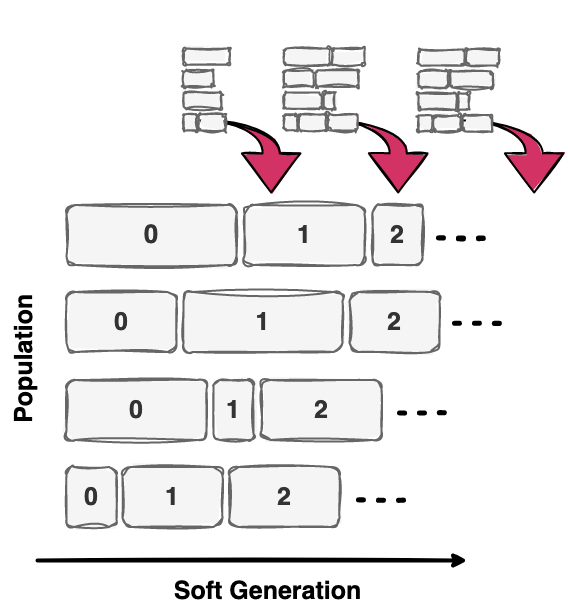
To alleviate the bottleneck inherent to synchronous parallel algorithms, we introduce Propulate, a massively
parallel evolutionary optimizer with asynchronous propagation of populations. Unlike classical parallel
population-based algorithms, Propulate maintains a continuous population of all evaluated individuals so far with a
softened notion of the typically strictly separated, discrete generations. This enables asynchronous evaluation,
variation, propagation, and migration of individuals with maximum computational efficiency.
Asynchronous Propagation of Populations
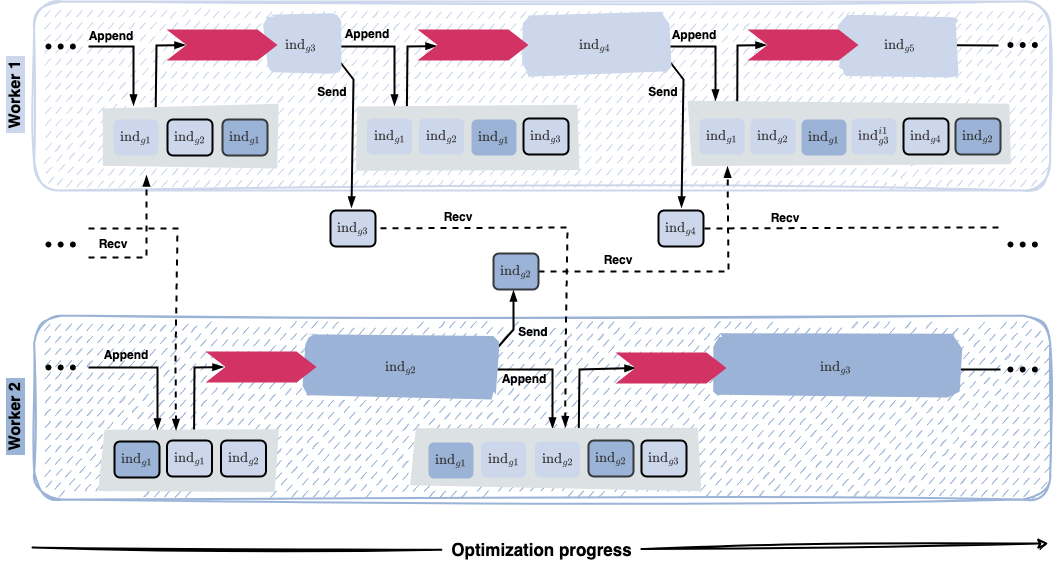
How this exactly works is shown in the figure below, depicting the interaction of two workers. Individuals bred by worker 1 and 2 are shown in light and dark blue, respectively. Their generations are given by a subscript. Populations are depicted as grey boxes, where most recent individuals have black outlines. Varying evaluation times are represented by sharp boxes of different widths. We illustrate the asynchronous propagation and intra-island synchronization of the population using the example of the light blue individual \(\small\mathrm{ind}_{g3}\). This individual is bred by worker 1 in generation 3 by applying the propagator (red) to the worker’s current population. After evaluating \(\small\mathrm{ind}_{g3}\), worker 1 sends it to all workers on its island and appends it to its population. As no evaluated individuals dispatched by worker 2 await to be received, worker 1 proceeds with breeding. Worker 2 receives light the blue \(\small\mathrm{ind}_{g3}\) only after finishing the evaluation of the dark blue \(\small\mathrm{ind}_{g2}\). It then appends both to its population and breeds a new individual for generation 3.